
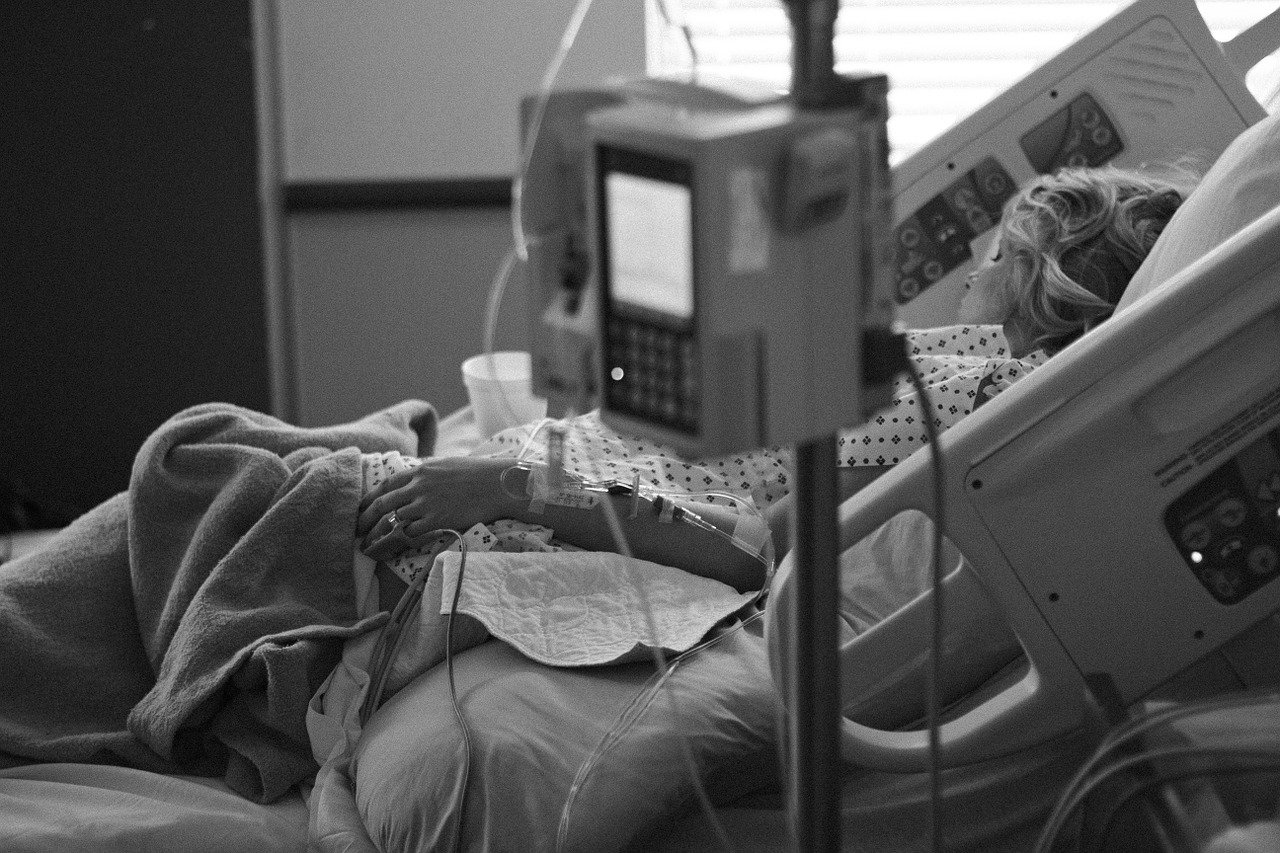
The British Medical Association (BMA) has issued guidance to its members on how to help patients carry out their plan when they decide to starve themselves to death, which is a form of suicide,
Doctors are to offer tips on altering a patient’s diet in preparation for starvation or fatal dehydration. It instructs relatives not to offer food, and tells doctors what to do if a patient asks for food and water when delirious.
While the document explicitly denies it is concerned with enabling or assisting suicide, Dr Anthony McCarthy, the director of the Bios Centre, a bioethical research group, says “doctors are actively encouraged to advise suicidal patients on how to prepare for and carry out their suicidal plan most comfortably”.
“Faced with a suicidal person determined to starve and dehydrate themselves to death, the BMA tells its members that doctors should not ‘judge or try to persuade the patient to change their decision, and patients should not be put in a position where they are forced to justify or defend it’”.

Most Catholics in Australia who do not regularly attend Sunday Mass still retain a deep connection with their faith, according to a major new study.
The 176-page report “Absent from the Table: Catholics in Australia Who Do Not Regularly Attend Sunday Mass”, found that 65% of study participants described faith as being very important in their lives, 64% said they prayed regularly, 55% affirmed the doctrine of the Real Presence, and 40% reported sharing their faith with others.
The findings suggest that irregular Mass attendance does not necessarily mean Catholics have left the Church behind. They also raise the question of why, if many survey participants remain attached to Catholic belief, Sunday Mass does not occupy a central place in their lives, since the Church makes it a matter of precept to attend.
Participants made a wide range of suggestions about how they could be drawn back to weekly attendance, including offering more convenient Mass times, shortening services, and improving liturgical music.

In his address the Pope noted challenges that increasingly separate the Christian vision of marriage from the lived reality of young people.
“Young people continue to long for love, fidelity and belonging,” he said, “yet many find it difficult to embrace how such a vision of love can take shape in their own lives or to believe that a lifelong commitment is the condition for reaching what they desire.”
Speaking after Pope Leo, the president of the Pontifical Academy for Social Sciences, Sr. Helen Alford, called on participants – especially the bishops – to “encourage young people to take up the great challenge of marriage and family life.”

A UK judge has criticised couples for making informal surrogacy arrangements and warned he would refuse to grant parental recognition if sufficient due diligence was not taken. Almost all European countries ban commercial surrogacy, and several also ban so-called ‘altruistic’ surrogacy.
Two individuals, D and C, sought a parental order for a child, G, who was conceived and born in China via surrogacy. Surrogacy is illegal in China and surrogacy arrangements are generally held to be invalid by Chinese courts.
The contracting couple, the judgment noted, “were entirely unaware that commercial surrogacy was illegal”.
The judge found it was appropriate to make a parental order in this case, as it was in the child’s ‘best interests’, but described the couple’s choice as “unwise”.
The judge added a warning for all others that his decision was “not a licence to engage in unlawful commercial surrogacy arrangements abroad”.
“Would-be parents who are contemplating entering into a commercial foreign surrogacy arrangement should be in no doubt that court will not make a parental order simply because the court is presented with an apparent fait accompli based on the fact that the subject child is already in the care of the intended parent.”

Undercover researchers filmed at this year’s Future Fertility Show in Dublin encountered the widespread promotion of several add-ons that have been rated red by the UK regulator.
This means that they have both potential safety concerns and also may reduce the effectiveness of IVF treatment.
However, unlike in the UK, while doctors here are regulated by the Medical Council, there is no independent statutory regulator overseeing fertility treatment.
Caitríona Fitzpatrick of NISIG, Ireland’s national infertility charity, said the fertility sector needs more policing as people struggling to have a baby are often desperate for a solution.
“Fertility is one of the hardest areas for people to spot misinformation on because the people looking at it are under such stress and they’re such a vulnerable group. But it has one of the highest levels of misinformation,” Ms Fitzpatrick said.
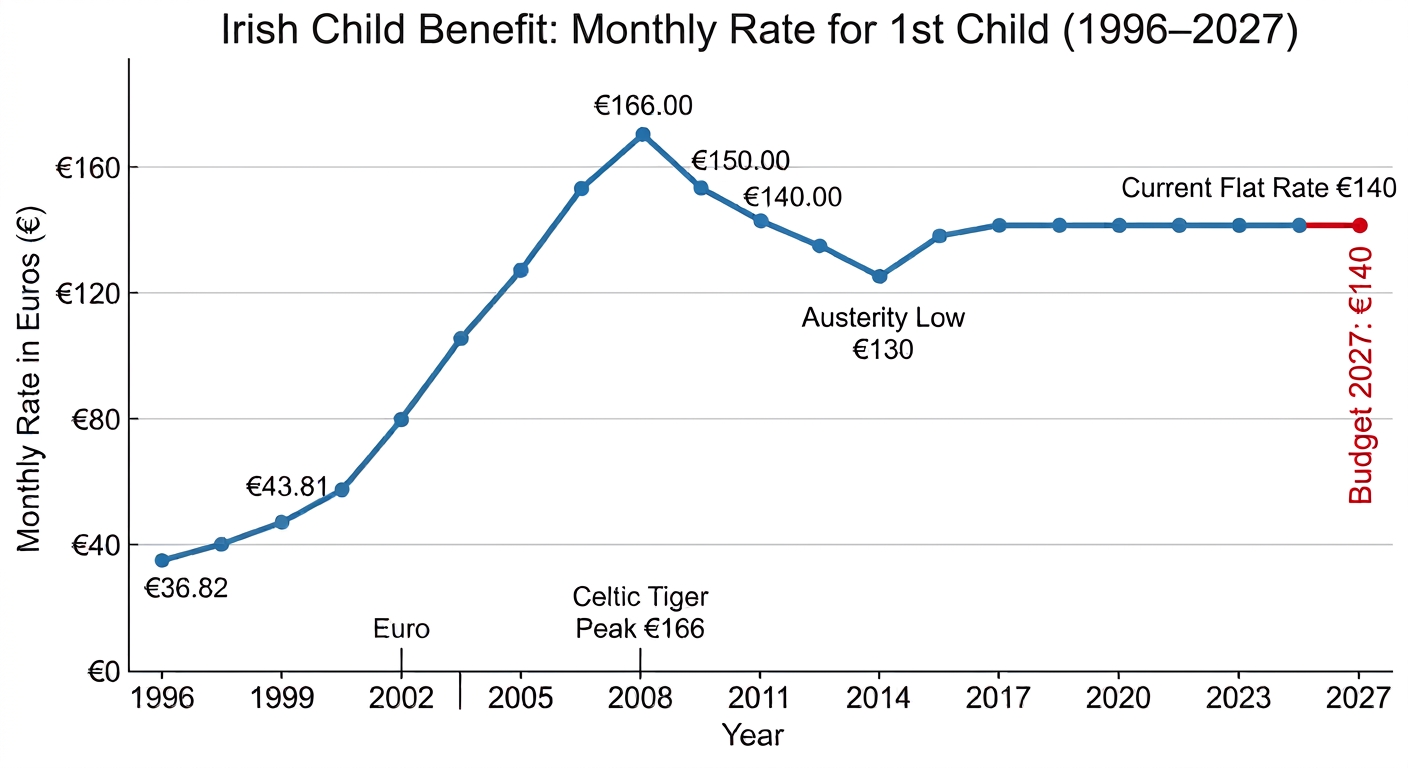
Budget 2027 has not given any increase to Child Benefit, marking the 11th straight year the payment has remained stagnant.
The monthly payment remains at €140 per child aged 18 and under, the same as it has been since the last rise in 2016, despite years of heavy, compounding inflation since then.
If it was inflation adjusted it would be over €180 per month now.
On the other hand, the Government announced another increase to the subsidy for daycare.
This nudges parents in the direction of using institutional childcare, whether they want it or not, whereas Child Benefit gives them full discretion over how to spend the economic assistance for raising their children.
The policy preference for institutional daycare over letting parents decide for themselves comes despite the electorate’s massive rejection of the Mother in the Home referendum in 2024.
It also comes despite polls consistently showing that parents would prefer to look after their children at home.
Around €2 billion per annum is spent on Child Benefit currently and about €1.5 billion is spent on daycare with this figure due to increase further next year.

A UN official has warned France about punishing women for stating safety concerns about men in women’s spaces.
The moves comes after a Paris court fined a female French journalist for criticising the placement of biologically male, transgender inmates in female prisons.
Reem Alsalem, the UN Special Rapporteur on violence against women and girls, said on October 2 that she was seriously concerned by the conviction and by other proceedings linked to the journalist’s statements on sex and gender.
“As women, saying that we need to exercise caution around men, particularly where there are reasons to fear for our safety, does not in itself constitute hate speech,” Alsalem said.
Women “should not be sanctioned for expressing concerns about their own safety or that of other women and girls”.
The French Government has not yet replied in public.

An elite university at the heart of Silicon Valley has seen a threefold increase in conversions to the Catholic Church this past year.
The Catholic chaplaincy to the university is run by Dominican fathers.
Father Bart Hutcherson OP, says the students are drawn to the beauty of traditional forms of worship — age-old hymns played on a pipe organ, Latin prayers and the ornate Byzantine details at Stanford Memorial Church.
He added that the high-achieving students are often first attracted to Catholicism on an intellectual basis, educating themselves on church’s history and centuries-old philosophical traditions before taking the plunge.
Six hundred Stanford students packed into a recent Saturday afternoon Mass of the Holy Spirit — hundreds more than Hutcherson would have expected just a couple of years ago.

The Christian presence in the Holy Land is under threat, according to Father Bernard Poggi, rector of a Catholic seminary near Bethlehem.
Fr. Poggi made his remarks during a Day of Prayer for Christians in the Middle East, organised by Aid to the Church in Need (ACN) Germany.
“Nobody has to explicitly order Christians to leave the country,” Fr Poggi said. Rather, it is the cumulative effect of many different pressures that makes staying increasingly difficult: roadblocks, inaccessible farmland, a lack of work permits, intimidation, and a lack of prospects for the future.
Poggi expressed particular concern about the increase in violence by Jewish settlers. Among other examples, he referred to Taybeh, the last entirely Christian village in the West Bank. “When fields, vehicles, homes, or churches are attacked, the consequence is always the same: it becomes more difficult for Christians to remain in their homeland, and the space in which they can live becomes increasingly restricted.”
Christians also face hostility in Jerusalem. Poggi described a recent visit with young seminarians where children approached them and spat at them because of the crosses they were visibly wearing.

In 2022, an estimated 123,802 people aged 50 and over received family care. This number is projected to increase by 49 to 58 per cent by 2040.
If people not currently in receipt of care but experiencing difficulties with basic personal care or carrying out tasks needed for independent living are included, then the projected number of people requiring care would more than double.
Population ageing is the main driver of the projected increases in care need, followed by population growth. Assumptions about healthy ageing could offset some of the projected increase but not remove the underlying pressure from population ageing.